Resources for leadership
Personal philosophy
- Have key values, and share them
- Don't compete with your team for work
- Make sure your team feels trusted and seen
Tools for leadership
Row the Boat
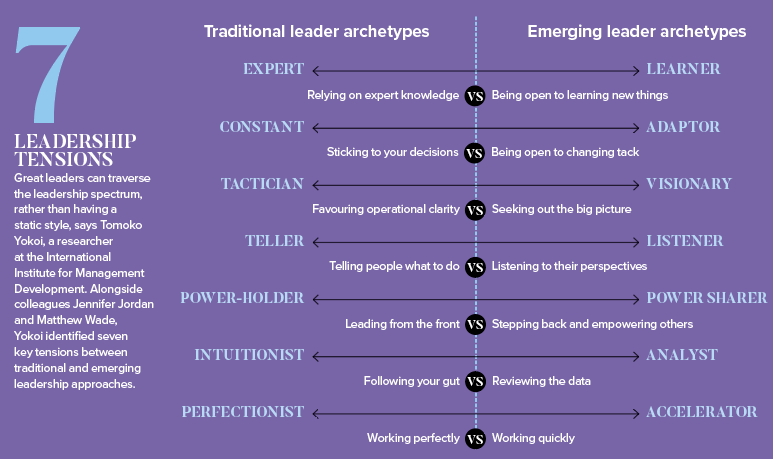
7 Tensions of leadership
Asking good questions
The Value of Questions Over Answers
- Questions are becoming more valuable than answers... a lot of times what you find at the root of it all is a great question, a beautiful question.
Curiosity-Driven Research
- Curiosity driven research as questions that we try to answer... buried in the answer might be something that could give us better fruit someday.
Decline of Questioning in Education
- A four-year-old girl is asking as much as 300 questions a day... questioning in schools by junior high school is almost at zero."
The Power of Naïve Questions
- I often start any project by asking a naïve question... that process can take us to something that is more concrete.
Questions as a Survival Skill
- Questions aren't just important to innovators or tech people. They're a survival skill for all of us.
The Superpower of Asking "Dumb" Questions
- Asking dumb questions can take many forms... the dumb question that is sitting right there that no one seems to be asking is the smartest question you can ask.
Journaling and Absurd Questions
- Journaling as an adjunct to asking these questions is very, very important... if you have 10 percent that leads you in an interesting direction that could completely revolutionize your business or your life.
Small Talk
Goals of Small Talk
Your goal is to be interested, not interesting. It's better to think of a conversation as a collaborative effort instead of a competitive effort.
Use Active Listening
It's ok to pause and have an appropriate response. Some tools to help with that:
- Paraphrase what the other person said by distilling the content
- Practice listening actively and understanding what is being said
- Use "Tell me more" to give yourself more time to think about the content
When it's your turn to speak
- Be concise. Tell me the time, don't build me the clock.
- I take this to mean that we should trust others to speak up if they need to understand more.
- Use structure to help. Using "How are you" is not good because it doesn't go anywhere. Instead, use "What, So What, and Now What?" as the framework.
- An Example of this at work:
- What bring your into work today?
- Why is that work needed?
- What happens after you're done with that work?
Ending conversations
- Recall that it's a collaboration. We often end conversations abruptly instead of signaling that the conversation is ending.
- Instead, let people know you're leaving but ask them one more question.
Decision Journal
You can think of a decision journal as quality control for our thinking — something like what we’d find in a manufacturing plant or a restaurant. Using a decision journal is simple but not easy. Implementing one requires discipline and humility.
https://fs.blog/decision-journal/
Good note taking tools
Consider adopting a note taking tool that will help you remember conversations and keep your promises.
4Cs of influence
Resources
Books on Leadership
Personal Growth
Atomic Habits - Mark Clear dig into the science of building habits that stick. Building strong, positive habits in your life will help leaders be more effective.
Start with Why - Simon Sinek Classic book on how to sell an idea effectively. Leaders build consensus and use their influence to push everyone in one direction.
Building a Second Brain - Tiago Forte Keeping track of many things at once is difficult without having a system. This book talks about how to start one.
The Five Dysfunctions of a Team - Patrick M Lencioni reveals some of the trappings of how teams become dysfunctional, and how to get over it.
For Engineers
The Cathedral and the Bazaar - Eric S Raymond goes over the history of software development and how Linux proved that complex software can be developed in a distributed way. The lessons discussed can be further generalized into an analysis of how people organize themselves in general.
Articles on Leadership
https://fs.blog/circle-of-competence/
https://www.buildingasecondbrain.com/resources
Tips on Retrospectivesp